Paper Questions (Raw)
Q1. A resistance carries a current of 2 A . When its ends are connected to a copper wire, of negligible resistance, i.e. when it is short circuited, then current through it will be
Q2. In the given figure, (V_{1}) is
1) (\frac{200}{3} V)
2) (\frac{100}{3} V)
3) (\frac{50}{3} V)
4) 50 V
Hint: (V_{1}=iR R_{1}=(\frac{V}{R_{1}+R_{2}}) R_{1}) (( \frac{100}{25+50}) \times 25=\frac{100 \times 25}{75}=\frac{100}{3} V)
Q3. In the given figure, current through (6 \Omega) is
1) 1.5 A
2) 1.2 A
3) 0.8 A
4) 1.8 A
Hint: If (i_{1}) be current in (6 \Omega) and ((i-i_{1})) be current through (9 \Omega). (\therefore 6 i_{1}=9(i-i_{1})) (6 i_{1}=9 i-9 i) (15 i_{1}=9 \times 3) (i_{1}=\frac{27}{15}=1.8 A)
Q4. In the given figure, applied voltage V is (All resistances are in (\Omega) )
1) 35 V
2) 45 V
3) 50 V
4) 55 V
Hint: (V_{2}=V_{3}) (20 \times 0.5=10 \times i_{2}) (i_{2}=1 A) (i=i_{1}+i_{2}=0.5+1=1.5 A) (V_{1}=30 i=30 \times 1.5=45 V) (V_{2}=20 \times 0.5=10 V) (V=V_{1}+V_{2}=45+10=55 V)
Q5. Current through (40 \Omega), (60 \Omega) and (20 \Omega) resistance, respectively
1) 6 A each
2) 2 A each
3) (6 A, 4 A, 12 A)
4) (12 A, 4 A, 6 A)
Hint: The circuit becomes
(i_{1}=\frac{240}{40}=6 A) (i_{2}=\frac{240}{60}=4 A) (i_{3}=\frac{240}{20}=12 A) 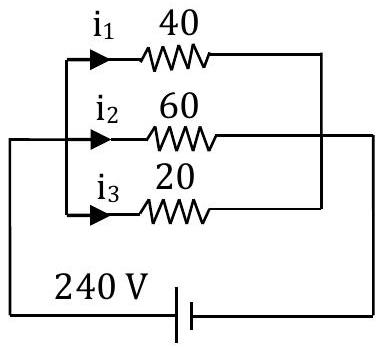
Q6. Two resistors, (X) and (Y), having resistances (R) each, are connected in series across a potential difference (V). When a resistance R is connected in parallel to Y , the percentage change in the potential difference across it will be
1) (17 %)
2) (25 %)
3) (-17 %)
4) (-25 %)
Hint: $$ \begin{aligned} & % \Delta V=\frac{\frac{V}{3}-\frac{V}{2}}{V} \times 100 \\ & =-\frac{V / 6}{V} \times 100=-\frac{100}{6}=-17 % \end{aligned} $$
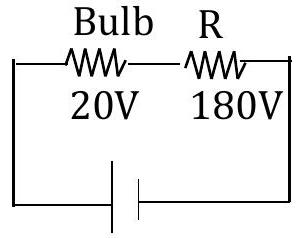
Q7. To use a bulb, rated at (20 V, 6 W), with a 200 V source, you have to connect a resistance
1) in parallel with the bulb.
2) in series with the bulb.
3) in series or in parallel with the bulb.
4) none of the above
Hint: By connecting a resistance in series, 200 V gets divided into 2 parts, 20 V are as bulb and 180 V are as resistance.
Q8. In the accompanying circuit, if the resistance of (R_{2}) is decreased, then
1) the current through (R_{1}) increases.
2) the current through (R_{1}) remains constant.
3) the voltage drop across (R_{2}) decreases.
4) the power dissipated by (R_{2}) decreases.
Q9. Three conductors draw currents of (1 A, 2 A) and 3 A respectively when connected in turn across a battery. If the series combination of them is connected across the same battery, the current drawn will be
1) 5 A
2) >1 A but < 2 A
3) < 1 A
4) (\frac{5}{7} A)
Q10. If the current I in the given circuit is 0.1 A , then (R=)
1) (3 \Omega) (30 \Omega)
2) (30 \Omega)
3) (60 \Omega)
4) (300 \Omega)
Hint: (R_{eff }=R||(R+R)=R|| 2 R=\frac{2 R}{3}) (R_{eff}=\frac{V}{I}=\frac{4}{0.1}=40 \Omega) (\frac{2 R}{3}=40) (R=\frac{40 \times 3}{2}=60 \Omega)
Q11. In the circuit shown below, the total resistance of the circuit between points (P) and (Q) is also equal to (R). The value of the unknown resistor (R) is
1) (3 \Omega)
2) (\sqrt{39} \Omega)
3) (\sqrt{69} \Omega)
4) (10 \Omega)
Hint: (R=3+\frac{10 \times(3+R)}{10+(3+R)}) (R-3=\frac{(30+10 R)}{(13+R)}) ((R-3)(R+13)=10 R+30) (R^{2}-3 R+13 R-39=10 R+30) (R^{2}=69) (\therefore R=\sqrt{69} \Omega)
Q12. The current through the (4 \Omega) resistor is
1) 0.5 A
2) 0.4 A
3) 3 A
4) 0.3 A
Hint: (R_{eff }=[4||12]+2=3+2=5 \Omega) (I=\frac{V}{R_{eff}}=\frac{2}{5}=0.4 A) Voltage across (4 \Omega) is (V_{1}=IR=0.4 \times 3=1.2 V) (I_{1}=\frac{V_{1}}{R_{1}}=\frac{1.2}{4}=0.3 A)
Q13. Two resistors P and (Q(P>Q)) are connected in series as shown in figure. With the usual symbols, which of the following is NOT true?
1) (V_{AB}>V_{BC})
2) (V_{C}
3) (I_{1}=I_{2}=I_{3})
4) (V_{B}>V_{A})
Hint: For series combination, (I_{1}=I_{2}=I_{3}) As current flows from A to C , (V_{A}>V_{B}>V_{C}) (V_{AB}=I_{1} P) (V_{BC}=I_{2} Q) As (P>Q) and (I_{1}=I_{2}), (V_{AB}>V_{BC})
Q14. Three voltmeters (A, B) and C having resistances (R, \frac{3}{2} R) and 3 R respectively are X - (A) connected as shown in the figure. When some potential difference is applied between X and Y , the respective voltmeter readings are (V_{A}, V_{B}) and (V_{C}). Then
1) (V_{A} \neq V_{B}=V_{C})
2) (V_{A} \neq V_{B} \neq V_{C})
3) (V_{A}=V_{B} \neq V_{C})
4) (V_{A}=V_{B}=V_{C})
Hint: (V_{A}=IR) (V_{B}=\frac{2 I}{3} \times(\frac{3}{2} R)=IR) (V_{C}=\frac{I}{3} \times(3 R)=IR) (\therefore V_{A}=V_{B}=V_{C})