J J Science Academy
1. Statement 1: If a plane glass slab is placed on the letters of different colours, all the letters appear to be raised up to the same height. Statement 2: Different colours have different wavelengths.
2. A vessel is half filled with a liquid of refractive index $\mu$. The other half of the vessel is filled with an immiscible liquid of refractive index $1.5 \mu$. If the apparent depth of the vessel is $50 \%$ of the actual depth, then $\mu=$
3. A ray of light that strikes a plane mirror PQ at an angle of incidence of $30^{\circ}$, is reflected from the plane mirror and then strikes a second plane mirror QR placed at right angles to the first mirror. The angle of reflection at the second mirror is
4. With respect to air critical angle in medium for light of red colour $[\lambda_{1}]$ is $\theta$. Other facts remaining same, critical angle for light of yellow colour $[\lambda_{2}]$ will be
5. A glass slab is immersed in water. The critical angle for glass-water interface is $[^{a} \mu_{\mathrm{g}}=1.54,{ }_{\mathrm{a}} \mu_{\mathrm{w}}=1.33]$
6. A ray incident normally on the face AB travels as shown in the figure. The minimum angle $\theta$ is,

7. A rectangular block of glass is placed on a printed page lying on a horizontal surface. Then the minimum value of refractive index of glass for which the letters on the page are not visible from any of the vertical faces of the block is
8. We have a right angled isosceles prism. Its refractive index is 1.5. If we incident a ray normally on one of the two perpendicular surfaces, which of the following phenomenon will take place?
9. Refractive index of a medium is $\mu$. The incidence angle is twice that of refracting angle. The angle of incidence is
10. A monochromatic beam of light passes from a denser medium to a rarer medium. As a result
11. The time taken by the sunlight to penetrate 2 mm glass slab (refractive index $=1.5$) is
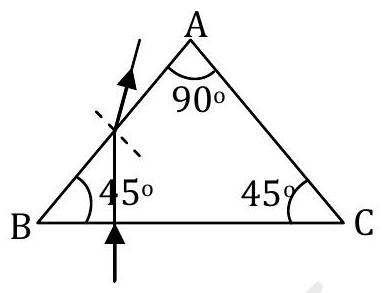
12. The refractive index of a material of a prism of angles $45^{\circ}-45^{\circ}-90^{\circ}$ is 1.5 . The path of the ray of light incident normally on the hypotenuse side is shown in
1) 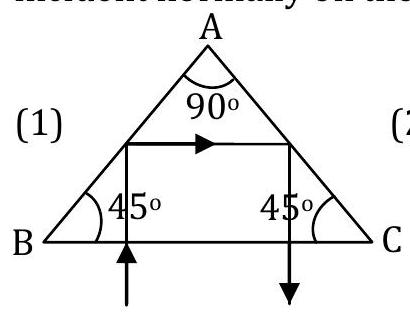 2)
2) 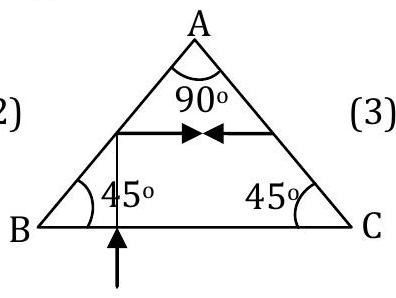 3)
3) 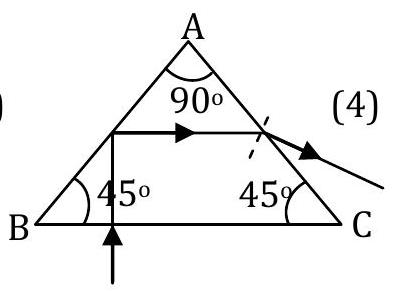 4)
4) 
2)
3)
4)
13. Two beams of red and violet color are made to pass separately through a prism (angle of the prism is $60^{\circ}$). In the position of minimum deviation, the angle of refraction will be
14. A certain prism is such that it produces a minimum deviation of $38^{\circ}$. It produces a deviation of $44^{\circ}$ when the angle of incidence is either $42^{\circ}$ or $62^{\circ}$. The refractive index of material of prism is
15. In a glass prism,
16. The angle of minimum deviation for a glass prism (R.I. 1.5) placed in air is $3.8^{\circ}$. The minimum deviation produced, when it is placed in water (R.I. 4/3), is
17. White light is passed through a prism of angle $5^{\circ}$. If the refractive indices for red and blue colours are 1.641 and 1.659 respectively, then the angular dispersion between them is
18. The dispersive power of a prism is dependent on
19. The dispersive power of for a glass is 0.0155 . If the R.I. of violet colour is 1.65 , then R.I. for red glass is
20. A thin prism of angle $15^{\circ}$ made of glass of refractive index $\mu_{1}=1.5$ is combined with another prism of glass of refractive index $\mu_{2}=1.75$. The combination of the prisms produces dispersion without deviation. The angle of the second prism should be
21. A fish observes a bird diving vertically down towards it with speed $20 \mathrm{m} / \mathrm{s}$. The actual velocity of bird is $\_\_\_\_\_$ m/s. [Given : $\mu=\frac{4}{3}$]
22. A point source of light is kept below the surface of water $((\mu_{\mathrm{w}}=\frac{4}{3}))$ at a depth of $\sqrt{7} \mathrm{m}$. The radius of the circular bright patch of light noticed on the surface of water is $\_\_\_\_\_$ m.
23. The ratio of thickness of plates of two transparent mediums A and B is $6: 4$. If light takes equal time in passing through them, then refractive index of B with respect to A will be $\_\_\_\_\_$
24. A beam of light is incident at an angle $30^{\circ}$ with the surface of an equilateral glass prism, of R.I. 1.5. On emerging from the prism, the ray will be deviated from its original path by $\_\_\_\_\_^{\circ}$. [$\sin ^{-1}(0.577)=35^{\circ}, \sin ^{-1}(0.422)=25^{\circ}, \sin ^{-1}(0.633)=39^{\circ}$]
25. Two glass prisms $\mathrm{P}_{1}$ and $\mathrm{P}_{2}$ are to be combined together to produce dispersion without deviation. The angles of the prisms $\mathrm{P}_{1}$ and $\mathrm{P}_{2}$ are selected as $4^{\circ}$ and $3^{\circ}$ respectively. If the refractive index of prism $\mathrm{P}_{1}$ is 1.54 , then that of $\mathrm{P}_{2}$ will be $\_\_\_\_\_$