J J Science Academy
1) The graph shows variation of current against applied potential difference, of a wire. The resistance of the wire is

Hint: $$R=\frac{dV}{dI}=\frac{15-5}{(6-3) \times 10^{-3}}=\frac{10}{3} \times 10^{3} \Omega=3.3 k \Omega$$ 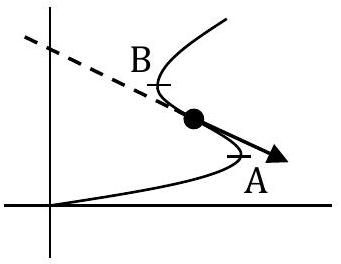
2) In which region of V-I graph of a specimen, is the resistance negative?

Hint: $$Slope = R = \frac{V}{I}$$ At any point between A and B , tangent drawn has negative slope. Hence resistance will be negative.
3) A metal rod is connected to a source of E.M.F. If it is compressed, so that its area of cross-section, increases by $(0.1 \%)$ , the current in it will
Hint: $$i=\frac{V}{R} \Rightarrow i \propto \frac{1}{R}$$ On stretching or compressing, volume is conserved. $$\therefore R \propto \frac{1}{A^{2}} \Rightarrow i \propto A^{2}$$ As $(A \uparrow es by 0.1 \%)$ , $(i \uparrow es by (2 \times 0.1 %) = 0.2 \%)$
4) A wire, having a resistance of $(6 \Omega)$ per unit area per unit length and length of 3 m , is connected to a source of potential difference of 18 V . The current through the wire, if area of cross-section is $(6 cm^{2})$ , is
Hint: $(\rho = Resistance per unit area per unit length)$ $$=6 \Omega-m$$ $$V=iR=i(\frac{\rho L}{A})$$ $$=\frac{VA}{\rho L}=\frac{18 \times 6 \times 10^{-4}}{6 \times 3}=0.6 mA$$
5) When a potential difference of V is applied across the ends of a conductor of length L , diameter of cross section $(D)$ , and resistivity $(\rho)$ , the current through it is $(I)$ . The potential difference per unit length of the conductor is
Hint: $$V=iR=i(\frac{\rho L}{\pi D^{2} / 4})$$ $$\frac{V}{L}=\frac{4 I \rho}{\pi D^{2}}$$
6) In an experiment, to study Ohm's law, a potential difference of 5 V is connected across a $(10 \Omega)$ resistance. An ammeter is connected in series with the E.M.F. source to measure the current and a voltmeter is connected across the resistance to measure the potential difference. The ammeter and the voltmeter readings can be i i = 5
Hint: Ammeter has its own resistance. $\rho$ Total resistance in circuit increases
7) Select the CORRECT statement.
Hint: Graph of Ohm's law is a straight line, characteristics of linear resistance is same.
8) A graph of potential difference between two points on a current carrying conductor and the distance between them is
Hint: